Intro

Sorry for the length, but I didn't have time to write a short blog.

Wednesday, March 18, 2020

Divisive Much?

Along the lines of stupid memes that I occasionally discuss, during this time of great problems like panic buying, economic turmoil and a possible rising death toll, posting political memes that deepen the divide are, quite honestly, unforgivable. It's the age-old problem that we've discussed before. Too many people have settled on getting their information from the political channels like Fox or MSNBC or from social media and never go out beyond their small bubbled comfort zone. They have, in effect, become brainwashed. (I will save that particular discussion for another day.)

What I find particularly sad is that these posters of the divisive don't even recognize the trap they've fallen into. They don't realize that they are not funny, just divisive and destructive.

Here is a couple such memes, I've seen today.

The goal is to help people not prop up extreme beliefs.

Adding a laughing face does not change that this meme is based not only on a disproven lie created possibly by Russian bots but also equates real deaths from a pandemic to this myth. And in case the poster didn't notice, there isn't a Clinton in an office right now.


Finally, I just wanted to add this one. It's not particularly divisive but as I would tell my literature students years ago, "There is always irony!"


Thursday, March 12, 2020

Why TP?


I am not even going to try to explain COVID-19 problems and panic. News media has stoked it well enough and governments trying to underplay it rather than being truthful have also made sure that the panic continues. Coronavirus is serious.

No, I want to talk about toilet paper hoarding. It is a worldwide phenomenon. Why?

 I've read this statement on Facebook a number of times: It's because TP comes from China and because of this people are worried we will run out. 

If you type into Google, "Where does toilet paper come from?" You will get a response from Wikipedia, "China." This is true. TP was invented in China in the 6th century. We don't, however, import the majority of our TP from China. We actually import from a number of countries 9.4 percent of our TP according to Observatory of Economic Complexity (OEC). The fact is toilet paper tends to produced where lumber is processed so TP comes from far away lands like Washington and Oregon and Vancouver. In other words where the growth forests are. Most of our imports actually come from Canada and Mexico.

Panic buying is not new and it is not reasonable. The current one for TP is worldwide. It may have actually started in Japan where because of an inaccurate Facebook post, the public was informed that germ masks were made from the same material as TP, and Japan does import TP and their masks from China. TP and the mask are actually two different materials. From there, like the virus, it spread to Australia and around the world. What happens is people see others suddenly start buying large quantities of a product and then start thinking, "What do they know that I don't?" Chances are they have heard that toilet paper comes from China or they saw what you are just now seeing. The fact is they don't know anything you don't know. They feel the situation is out of their control, so by panic buying things like masks, hand sanitizers, water, toilet paper, etc., they feel they have some control. It is really a "monkey see; monkey do" sort of thing or sometimes referred to as the herd mentality. 


So now you know. You really don't need all that TP or water, you need to calm down and take sensible precautions. 


Thursday, March 5, 2020

Fascinated by Bernie


I am fascinated by Bernie Sanders' run for the presidency. Don't get me wrong, I am not particularly a supporter, but fascinated by his rise and primary run. He, truly, does have a solid base of followers which I find as fascinating as those of Trump. You see, Sander's base doesn't seem to grow or show up when it comes time to vote, and yes, I have the stats to support this. Trump's avid, dare I say rabid, supporters are solid too but also don't seem to grow in number. The difference is they do tend to show up.

Rivals of Sanders point to his inflexibility and how little he has accomplished in his 29 years in the House and Senate. Supporters point to him as a voice for the downtrodden and democratic socialism. It is true that of the 422 bills he has been the lead sponsor on, he has had only three become laws and two of those were to name post offices which is from congress.gov.  This, however, is not truly reflective of his impact. For example, he pushed for and added funding for community health care centers in the Affordable Care Act. In fact, Bernie's real success is in amendments. He has offered over 500 amendments, esp. while he was in the House. About one in five of his amendments ended up being added to laws, but many of those were stripped from the final product.  His power, especially in the past number of years, has been that he is an unflinching ideologue. He creates public spectacles and grassroots pressure to get his ideas across. In other words, while his legislative accomplishments are pretty thin, his cause for change is as much about changing the conversation as it is about pushing congress for legislation. The question is though as President, will this same inflexible, single-mindedness serve him without compromise? The answer is probably going to be "yes" if he can get his base to show up and "no" if he is only yelling to the choir and no one else.


This brings me to the statement in the first paragraph. At a rally just before Super Tuesday, he had 13,000 supporters show up in Massachusetts.  Yet, he lost the state in the primary to Joe Biden who not only had no rallies in the state but had no offices and hadn't spent one dollar on advertising in the state. Sanders frequently points to the number of new voters he brings to the party, but the fact is the statistics just don't bear that out. The percentage of votes he had in 2016 was significantly lower in the recent primaries. He lost Oklahoma to Biden which he won in 2016. His claim of bringing in younger voters just isn't accurate. The youth vote on Super Tuesday was down in comparison to his 2016 bid. Again, his argument that he will bring in new voters only rings true if they show up, but so far in the primaries and caucuses, he hasn't turned out the numbers he did in 2016.


Despite Biden's claims on the debate stage, Bernie does have a list of how he plans on paying for his democratic socialist dreams. I am not going to say I disagree. I, too, believe that health care should be a right. The tuition loan programs are a nightmare, and I know more than a few people who make the required payments, and the loans only get bigger. There is nothing wrong with making sure that people can find shelter and food. Do, however, Bernie's plans cover the cost. The simple answer to a complex problem according to a number of nonpartisan experts is "no." To do all that he wants to do, it will cost roughly fifty trillion dollars. This figure includes the 13.3 trillion deficit that is courtesy of things like the economic downturn in 2007 which was just starting to come down when the Trump Tax Cut was passed with no funding.

Here's a list and cost according to the Washington Post:

Sanders’s Spending, 2021-2030:

1. Deficits under existing policies: $13.1 trillion
2. “Free” college for all and the cancellation of existing student debt: $2.2 trillion
3. Expand Social Security and other retirement benefits: $1.4 trillion (estimated by the Progressive Policy Institute)
4. Housing for all: $2.5 trillion
5. Eliminating household medical debt: $81 billion
6. Green New Deal (programs to stop global warming): $16.3 trillion
7. Universal child care and preschool: $1.5 trillion
8. Medicare-for-all: $17.5 trillion
Total: $54.6 trillion

So, if the government maintains its current spending over the next decade, then that means with the Sanders' plan added, the size of the government will be about 80% larger. If we do indeed pattern these plans on the democratic socialist states in Europe, we have to remember a few things. The USA is a huge, unruly landmass with a population of about 327 million people. Norway who has a number of these ideals on the books has a population of 5.3 million. That's a huge difference. If we raise taxes on the billionaires, we can expect some very high-priced lawyers and accountants who will make sure that the new tax does as little damage as possible. According to the nonpartisan Congressional Budget Office, if all spending were covered by deficit spending, we can expect the national deficit to grow to 66.8 trillion by 2030. The tax burden would have to nearly double to cover this. Now add the 50 trillion that Sanders' plan would add. The wealth tax would actually raise about only 4.3 trillion. You have to remember that the billionaires of the world don't just have their wealth in money it also in things that income tax doesn't include. Sorry, the math just doesn't bear fruit. 

And yet, Sanders' clear-eyed vision for a better world is what drives him, his followers, and my fascination for a 78-year old man who has captured the imagination of the young. He really does want to make things better and this brings me to another thing that fascinates me by this most unusual candidate. Bernie Sanders is not a Democrat and yet he runs in Democratic Primaries and Caucuses by registering as one in the states when he runs. He has, however, already filed for his Senate run in 2022 as an Independent. He actually did the same thing in 2016. There also is an actual party named The Democratic Socialists of America. Yet, Sanders will be the second person in what is now a two-man race for the nomination following Super Tuesday's results. 

I know many of his believers want to think of Bernie as the new center-left of the political spectrum. If you listen and read a lot of the Democratic base's statement, you might believe that the progressive movement is the only driving force in the party. But just as Trump's true believers think that their extreme position is representative of the Republican party, it isn't. If one actually looks at the main candidates that caught on from the original 20 plus running for the nomination, the math is very different. Biden, Klobuchar, Buttigieg, Bloomberg and even Steyer all who are recognized as center-left to center-right generally split 55 to 65 percent of the vote while Sanders and Warren, the far-left progressive of 30 to 45 percent. In the Iowa caucus Warren and Sanders took 44.1 percent and the middle of Biden, Buttigieg and Klobuchar took 54.3 percent. The outlier for Sanders has been Nevada where he took home 46.8 percent of the vote. Really, the support for Sanders doesn't really seem to grow. Even in California, his biggest win for delegates, he currently sits at about 33.8 percent. Admittedly, his vote totals would probably grow if Warren had dropped out sooner, but then again, so would've Biden, who currently sits at 25.1, if Bloomberg had dropped out and if Buttigieg and Klobuchar had also dropped out before early voting had started.

Perhaps the biggest problem that gets in Bernie's way, besides the socialist label and not really being a Democrat, is he actually is running against the party whose nomination he hopes to get. He runs an insurgent campaign that is fueled by idealism, perception and occasionally by
extreme supporters. He rails against the system often giving him the appearance of that stereotypical old guy yelling at kids to get off his lawn. Attacking the establishment of the party you want to endorse you is probably not a good idea. What's the old adage about biting the hand?

I don't know where you stand on Bernie Sanders, but I remain fascinated by him. 


Monday, March 2, 2020

Your Friends on Facebook Have the Electoral College Wrong


Odds are you've heard the arguments and depending on your political bent. Those on the
right tend to believe that the founding fathers created the Electoral College as a means to prevent the tyranny of the majority and protect the voting outside of the smaller rural numbers. Those on the left tend to believe that the founding fathers intended the Electoral College to prevent slaveholders from using their slave to create absolute control over the presidency by using slaves as votes they controlled for the president and also because the founding fathers thought the average citizen was not politically savvy enough to vote for the best candidate.

The latter is actually only somewhat true, while the whole tyranny of the majority is pure myth. According to historians which include Professor George Edwards III the actual case of the Electoral College was created by the founding fathers as a compromise and because they were tired. In short, it was a plan the was pieced together because the founding fathers were frustrated and ready to be done.

So, you need to understand a number of things. First, the Electoral College was never considered a great idea. The framers did have a strong mistrust of powerful executive branches because they had after all just fought the tyrannical control of a king and his appointed all-powerful governors.  The newly formed United States was the first country on the planet to ever actually elect their leader.

One group of representatives felt that the House of Representatives should elect the President because they really did worry that most of the citizens of the country were not politically aware enough to make an informed vote especially those in the rural areas. They also feared a "democratic mob" which would steer the country astray. Another group of framers felt that Congress should have nothing to do with the election since they felt that having such a small group elect the President made it rife for corruption and nepotism.

You also need to understand that at the time, there were no political parties. George Washington who would later be elected by unanimous vote did not belong to any political party. In fact, the framers believed that because of the lack of parties that the Electoral College would vote their conscience from among several candidates who ran for president. Boy, were they wrong.

The framers cobbled together a compromise that they could sort of live with. It has never worked. Next in this compromise came the problem of what to do with slaves. There actually was never an issue that slaveholders would use slaves to control the popular vote, but there was the problem of how to count slaves for the population of a state. Thus, was born the hideous three-fifths rule which counted a slave as only a three-fifths of a human being for purposes of calculating Federal taxes and electors for the Electoral College. It was by today's standards a shameful inclusion in the noble Constitution. It was a problem that would plague the US for decades to come.

So, the Electoral College which would allow states to appoint and control their own electors separate from the congress was born. None of the assumptions by the founding fathers proved to be true. They assumed that electors would vote their conscience despite the failure to instruct states how they would appoint their electors or divide them up in an election. The founders actually assumed that most presidents would be elected by the House of Representatives, which has only happened twice because the expected number of people to run for President didn't occur. The Electoral College was to elect by the majority. Following Washington as President, there ended up two parties emerging and states instructed electors exactly how to vote. The Electoral College became far more powerful than it was intended to be. This was added to by the 12th amendment of 1803 which allowed the political parties to designate one candidate to run for President.


This brings us to the new attempt to work around the Electoral College. The state law which allows states to instruct its electors to vote for the national popular vote is very Constitutional. The National Popular Vote law is not new. It has been around since at least 2001. Where it could run afoul of the Constitution will depend on how it is worded and how the Supreme Court interprets that wording. In the Constitution in Article I, Section 10 is the "Compact Clause." This clause states that one state may not make a compact with another without congressional approval.

This seems pretty straight forward, but there is a problem. The Supreme Court has already ruled that states do not need congressional approval if the compact involves internal state matters. Since the Constitution gives states internal control of the Electoral College, the question arises is the Interstate Popular Vote Law a compact that violates the Constitution's "Compact Clause" or does it meet the internal agreement outlined by the Supreme Court? You can also add the other rulings by the Supreme Court which also ruled twice, 1892 and 1969,  the state legislators have all but absolute control over their ability to instruct electors. But then there are also statements from the Court which says the compact clause comes into play when states “would enhance the political power of the member States in a way that encroaches upon the supremacy of the United States,” or “impairs the sovereign rights of non-member states.”  It is truly a "sticky wicket."

Look, I know that many of us have seen the maps which shows how if the Electoral College goes away how the popular vote would then be controlled by California, New York, Florida, and Texas. The Problem with that map is it assumes that everyone in California or Texas or another state will vote the same way. This is untrue. California has had a number of Republican governors which includes Ronald Reagan and Arnold Schwarzenegger, and Texas has had Democrat governors such as Sam Houston and Ann Richards. Many states have been at one time or another red and then blue or blue then red, no matter what you think you've heard.


Or maybe you've seen the red state vs the blue state map or the red vs blue voting map. This shows voting by states but these too are misleading. What you may have not seen is the actual map by the population. You see, land doesn't vote. People do. The red map suddenly becomes much less
red when we remove land from the equation.


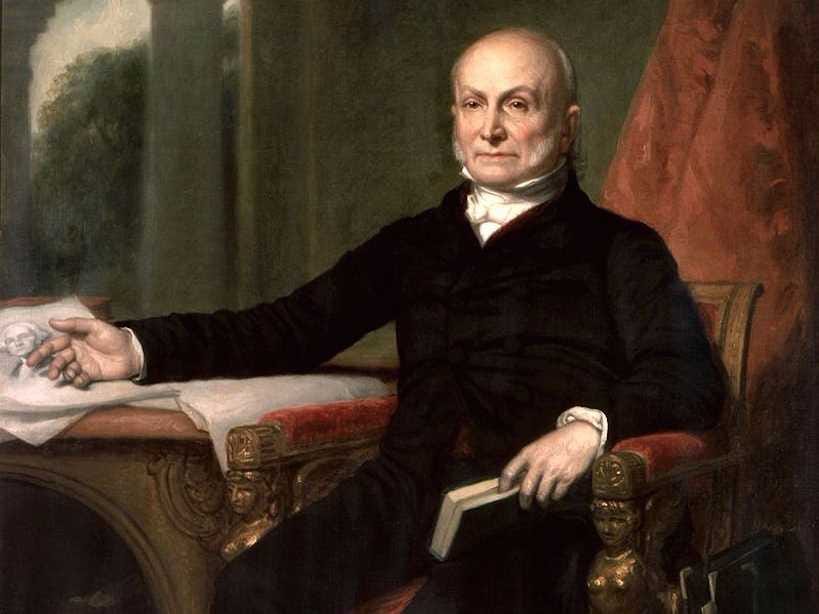
We have had five presidents who became president but did not win the popular vote. The first was John Quincy Adams who became President despite losing by 10.5 percent of the popular vote to Andrew Jackson. Adams actually failed to secure a majority in the Electoral College. There were four candidates in the electoral college that year. Jackson only received a plurality of electoral votes and so in that case, Adams was elected by the House of Representatives. 

Then there was Republican Rutherford B. Hayes who was elected by the Electoral College despite losing by .8% of the popular vote to Samuel J. Tilden. This one was a wild one. Hayes actually lost the Electoral College except for the fact that 20 of the Electoral Votes were disputed which would put Hayes one vote ahead of Tilden. A commission was formed to study the problem. Finally, it was
determined that Hayes should receive the 20 disputed votes and the Democrats agreed they would accept this only if Hayes would agree to just run for one term. This was called the Compromise of 1877.

Next was when Republican Benjamin Harrison lost to incumbent President Grover Cleveland by .8% of the popular vote. Harrison won handily in the Electoral College to become President.

Following this, it would be over a hundred years before it would happen again when Republican George W. Bush lost by .5% to Vice-President Al Gore. Gore lost in the Electoral College by just five votes following the infamous hanging chad votes in Florida where Gore lost by just 537 votes. In a controversial decision, the Supreme Court ended the recount effectively awarding the 29 electoral votes to Bush. Studies of the recount and its outcome are conflicted on who actually would have won Florida had the recount continued.

Finally, was when Republican Donald Trump lost the popular vote by 2.1% to Hilary Clinton. Trump's campaign use of the Electoral College caused one of the biggest upsets in election history. It was also very clear that the compromise of the Electoral College in 1787 could clearly be used for political gain.

The problem then is a simple one, quite honestly. It would appear that the four times the Electoral College has come into play it has favored one party. The Republican Party did not exist in the 1824 election. The Electoral College is not what it is portrayed on the Left or the Right. It was a compromise created not by some never wrong saints but a group of very human and tired and frustrated representatives. It has never worked as intended. The question is, do you support the Electoral College, or do you truly believe in "one person one vote"? You cannot have it both ways.

Thursday, December 26, 2019

The Magic of the Holidays


Since I was a child, I have always looked forward to Christmas time. It was more than just presents and the arrival of Santa. It was the feeling that happens starting with the holidays. I try to hold on that inexpressible feeling as long as I can. For me, it doesn't end on December the 25th. I don't know that it ever really ends but it does subside a bit as the new year begins to progress especially after all the decorations come down. Still, there is magic in the decorations, and mall Santa and the lights.

From my point of view, the most ridiculous thing you can tell me about is the "war on Christmas," which is something that was entirely fabricated to divide us. Why on earth would a business want to say "Happy holidays" instead of "Merry Christmas"? I don't suppose that it is because there might be other holiday events. The spirit of this time of year is one of acceptance and caring. It has little - or should have - little to do with whether we say, "Merry Christmas," or "Happy holidays," or  "Happy Hanukkah," or "Happy solstice," or "Happy Boxing Day," or "Happy Kwanzaa," or one of the other 20 plus holidays that occur in December,  some Christian and some not. In all honesty, no matter what has been said to me when I leave a store, no one has ever seemed offended by my wishing them a merry Christmas, and I've never been offended by them wishing me happy holidays.

There was a time that many businesses avoided involving their politics in their business. I know the last thing I want to do is go into a restaurant and hear how wonderful or how evil some politician or political party is. There are, in fact, several businesses that I don't go to because of this. I'm not talking about businesses that take a moral stance but ones that involve themselves in unadulterated politics. And there is a difference between the two. Standing on principles takes courage.

A while ago, I read an editorial. A good editorial is designed to make us think. Unfortunately, too often we confuse the editorials with the news. They aren't. The opinion of this particular editorial was that parents who tell children that there is a Santa Claus are creating a lie that ultimately will harm the child. The writer has missed the point. There is a magic to the holidays that I wish we could hold onto. That magic, that feeling, that is embodied by Saint Nick is the point. It is the gift, that is given to all of us at this time of year, and I don't mean toys. There is a magic in believing in someone who gives us so much just for being good. I believe. So I want to give you that gift or at least remind you of it. I hope your holidays, no matter which one you celebrate, are blessed and your life is filled with a little magic. It's not a lie to believe in the spirit of the holidays. Happy holidays.

Monday, February 25, 2019

Sorry, Cussing Does not Show Intelligence.


I've seen this on posts galore on Facebook and Twitter from friends and famous people. It seems a few news sites posted the results of a study that using swear words is a sign of intelligence. We've been through this before. A study does not mean it's true. A study must be replicated and independently verified. The research was done by Marist College and the Massachusetts College of Liberal Arts which across three studies they did, actually indicated that people who know taboo w
ords may have a stronger vocabulary. Saying this knowledge shows intelligence is a bit of a stretch.

 Intelligence actually had nothing to do with the studies, and the studies also did not discuss using cuss words. What they studied was the relationship between vocabulary and swearing It seems that if someone can produce in one minute more swear words than average which was 9, then that person seemed to also have a larger vocabulary.

In other words, just because someone knows the words, it does not mean they use them. Also if that person only knows the average, s/he probably has an average vocabulary. In fact, it may mean that the vocabulary allows the person to avoid the use of swear words. The study did not study the actual verbal and written use. It looked at just how many taboo words vs. the number of animal words and non-swear words the subject could produce in a minute.

This, however, is something that should be approached with caution. There is a difference between knowledge of taboo words and daily use of the words. Another problem for the research is all three studies were conducted by the same researchers. So, it has not yet been independently verified. The person may be able to cuss with the best of them, s/he doesn't need to.

It is a far leap from vocabulary to intelligence.


https://www.scientificamerican.com/article/is-swearing-a-sign-of-a-limited-vocabulary/
https://cpb-us-w2.wpmucdn.com/campuspress.yale.edu/dist/a/1215/files/2016/05/Giordano-rg5y5r.pdf

Thursday, February 21, 2019

End the Electoral College


Today, Colorado passed joining of the Popular Vote Act. The idea is for states to eliminate the Electoral College by making the state's electoral votes go to the popular vote winner. In effect, if enough states do this, the Electoral College will be effectively removed from the U.S. Constitution without an amendment. Colorado is not alone in this move. The National Popular Vote bill will take effect when enacted into law by states possessing 270 electoral votes.  It has been enacted into law in 12 states possessing 172 electoral votes. It has been introduced in all 50 states and has been passed by at least one chamber in several more states. Colorado's passage will add 9 more votes. This means that after 89 more electoral votes are added, the bill will take effect.

The Electoral College does not exist for the reason that many of you think it does. It was originally intended as an over-ride to the national vote. It was not intended for states to control how the electors voted but for the electors to be able to weigh the outcome of an election. You see, it was created because the Founding Fathers did not trust direct democracy, so they struck up with the idea of a republic. They worried that in a direct democracy a faction could become such a majority and that the rest would fall to what Alexis de Tocqueville referred to as "the tyranny of the majority."

What occurred though was the electoral college became something of a formality instead of protecting the democracy from a majority faction who "sacrifice to its ruling passion or interest both the public good and the rights of other citizens.” Alexander Hamilton believed that by having the electoral college “that the office of President will never fall to the lot of any man who is not in an eminent degree endowed with the requisite qualifications” and that the electoral college would be controlled "by men most capable of analyzing the qualities adapted to the station, and acting under circumstances favorable to deliberation, and to a judicious combination of all the reasons and inducements which were proper to govern their choice” (The Federalist Papers). 

Instead, the Electoral College is governed by political parties, and in 26 states the college does not reflect the popular vote of the state but instead is a winner take all proposition. This occurred because the Constitution does not stipulate how states are to use their electoral votes only that they have them and who cannot be members of the Electoral College. If you accept what was written by Hamilton, Madison and de Tocqueville, then electors were supposed to be what we now call faithless electors. They should be men and women who deliberate the qualifications of the candidate. 

I seem to recall reading this someplace. The Founding Fathers were worried about the understanding of the population at the time. They felt having an elected official voted in by a population who at the time probably had little in the way of understanding of the complexities of governing the original states. Many of the white males who voted were probably more concerned about daily survival than reading about governing needs. It may also be that the Founding Fathers were a bit arrogant in this regard especially since it is believed that by the time the Constitution was written the voting population was near 90 percent in literacy.  Nevertheless, information was probably much more slowly delivered then than it is now and counting all those votes by hand was hard.

Yes, I've seen this cartoon floating around about what would happen if it weren't for the Electoral College protecting us from those evil people in California, Texas and New York. Put aside that the cartoon is satirical in nature and has no real basis in fact. I have as much problem fathoming how these folks are evil because they live in a more populace area as I do thinking that the people in Denver or Boulder are tyrannical because they live in the most populated areas in Colorado. In propaganda terms, this is known as "the other" argument. It is a technique used to divide us. Making someone an enemy because they hold a different viewpoint or live somewhere else is wrong. IT IS WRONG! 

From a certain point of view, either we believe in one person one vote or we don't. As it stands, the Electoral College actually is the opposite of the above cartoon map, especially in the last election. It made the vote of less populated states more important than the vote of those in the more populated.  The case is not whether we suffer from the "tyranny of the majority" but are being abused by the minority. The electoral college has over-ridden the popular vote five times. John Quincy Adams (lost by 45,000) in 1824, Rutherford B. Hayes (lost by 250, 000) in 1876, Benjamin Harrison (lost by 90,000) in 1888, George W. Bush (lost by 540,000) in 2000, and Donald J. Trump (lost by 2.87 million) in 2016. 

The Electoral College was never intended as a rubber stamp nor was it intended to be used, abused or manipulated by political parties to over-ride the will of the people and for the majority to fall prey to the tyranny of the minority. It was never intended to protect us from "the others" who are also United States Citizens. Like other limitations placed on direct democracy such as not allowing women to vote, counting humans as 3/5ths of human to keep slaveholders from dominating the House, or having states appoint senators, it is time for this abused constitutional doctrine to be eliminated.